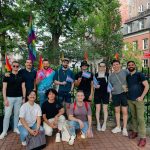

I’ve been thinking a lot about the word “liberation” lately. What does the word mean to me? What does it mean to guests who join us on tour? To some extent, it feels like a buzz word that some activist quoted in a speech decades ago. But I don’t think that could be further from the truth. Like the LGBTQ+ history we share on our tours, the word liberation is not some faded concept in a history book. It’s an ever-growing history that is continually changing, evolving, and growing, and is more relevant now than ever before.
On every tour, I emphasize the importance of language. Initially, this started because of the generational and global differences in the use of the word “Queer.” While the majority of the world has reclaimed this term as an umbrella category for the LGBTQIA+ community, there are some folks who still feel slighted by it (and rightly so, as the word was used in a derogatory fashion through most of the 20th century). Language matters, especially as someone who is speaking to various identities, experiences, and social issues.
As a full-time tour guide, my job is to talk non-stop for two hours. So, it makes sense why I like to emphasize the importance language. But reflecting back on my earlier years, the importance of language is something that has resonated with me throughout my whole life. From an early age, I understood the importance of words – how uplifting or demolishing they could be. One of my earliest childhood memories is of me sitting at the front of the school bus, nose buried in a book, and a classmate calling me a gay slur. I didn’t know how to respond, so, I stayed in my book.
I’ve always been a bit of a book worm, or some might say a nerd. And honestly, nerds make great tour guides. We are a wealth of knowledge and information! It’s no surprise that I went on to study English language and literature in college and began writing a book about LGBTQ+ history, which is ultimately how Christopher Street Tours started. Rather than finishing the book, I decided to turn my research into a walking tour, and the rest is history.
Liberation is one of those words that comes up often on our Village Pride walking tour. We share stories of the Gay Liberation Movement, including the birth and evolution of Christopher Street Gay Liberation Day and organizations that were created soon after the 1969 Stonewall Riots, like the Gay Liberation Front. We visit the Gay Liberation Monument and talk about the figures that represented liberation in 1979, when the monument was commissioned, and how our definition of liberation has changed over time. As a tour guide, I might say the word “liberation” dozens of times over the course of one tour, but what does it truly mean? And am I emphasizing its importance enough, especially in the “context of all in which you live and what came before you?” (insert Kamala Harris meme about falling out of a coconut tree).
Just kidding about the coconut trees. Kind of.
To me, liberation is not just some historic word, part of an old movement. As Queer people, and as humans in 2024, liberation is a concept that most of us are still actively seeking. What does it mean to be liberated in 2024? To be free?
In telling the story LGBTQ+ history, I wish it was as simple as “LGBTQ+ activists fought for our rights and now we have them. Case closed.” Unfortunately, it’s more complicated than that. Yes, we do have certain rights today that activists of the past have fought for and won. The mission of Christopher Street Tours is to share stories and uplift voices of those who paved the way before us, and I feel passionately and strongly about doing so. There are countless activists who have paved the way for us, and now we live with certain freedoms that were unthinkable for previous generations. I feel grateful every day that I can hold my husband’s hand in public. I feel grateful that I can even legally have a husband! And while I’m aware of the heteronormativity of marriage as an Institution, I’m also knowledgeable enough to know that marriage grants us certain legal protections. Yet, even as I write this, amidst an upcoming president election, I know that those protections are not as guaranteed in the United States as I may have once assumed.
So, how are we continuing to pave the way in the name of those that came before us? And where is the current movement? Are we still fighting for “liberation” or is there another term that feels more relevant, more appropriate, for the current effort?
I could keep rambling on, sharing my musings, but the reality is that I’m not really sure what’s next for the LGBTQ+ rights movement. When people ask me that question on the end of my tours, I usually share thoughts about intersectionality…how our movement needs to be more intersectional, not only within our own community (advocating for all people within the LGBTQ+ community), but also intersectional across movements. I recently read Angela Davis’ “Freedom is Constant Struggle” which reemphasizes the concept that there can’t be liberation without liberation for all. In the 1950s, LGBTQ+ activism was mostly “assimilationist.” The idea that members of the LGBTQ+ community needed to assimilate into heteronormative culture and prove that they were “productive members of society.” Respectability politics. This is why photos of early LGBTQ+ rights protests from this time are mostly of men in suits and women in long skirts and dresses. The Stonewall Riots of 1969 threw all of that out the window, entering a new era of Gay Liberation, with young, Queer protestors chanting into the streets, dressing and acting however they wanted, no longer needing to wanting to fit into a prescribed box. Where do current Queer folks fall into these categories? Or, is there a new definition of Queer activism on the brink?
So, whatever liberation means to you, and however you incorporate that into your own life, I hope that we all continue to pave the way forward, creating positive social change in our own spheres of influence, and inspiring generations of the past, present, and future.