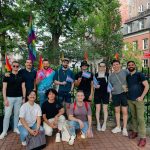

When we think about social change, it’s easy to imagine huge organizations and sweeping movements changing the world. But the truth is, so much of the progress we celebrate today started with small groups of people, or collectives, thinking about ways that they can make a difference. There is power in small groups, chosen families, friend groups…people who came together around kitchen tables, bookstore counters, or cramped apartments with a dream for something better.
Some of the most powerful chapters in LGBTQ+ history remind us that it doesn’t always take a crowd to spark a revolution. More often than not, the story begins with a few people who have a vision and the courage to enact that vision.
Our guests love learning about the LGBTQ+ history in New York City, but so often, they’ll end the tour by asking, “What now? What next? How can I get involved?” Sometimes, learning about these movements feels overwhelming and intimidating, but by sharing a few examples of stories that show up on our LGBTQ+ Village Pride tour, activism becomes more tangible and accessible to everyone.

Craig Rodwell & Christopher Street Gay Liberation Day
Craig Rodwell was a trailblazing activist that spent most of his life advocating for LGBTQ+ rights. He participated in the Julius’ Sip-In in 1966 and opened the Oscar Wilde Memorial Bookshop in New York City in 1967 – the first gay and lesbian bookstore on the east coast. He founded the Homophile Youth Movement in Neighborhoods, an early LGBTQ+ youth organization, and was a participant at the Stonewall Riots. After the Riots, Craig and a handful of close friends formed the Christopher Street Liberation Day Committee. The vision of the committee was to commemorate the one-year anniversary of the Stonewall Riots with a protest march starting in Greenwich Village and ending in Central Park. What started as a bold idea among friends ultimately became the first Pride March, now celebrated by billions of people all across the world.

Liberation House: Two Friends & Some Folding Chairs
Founded in 1972, Liberation House was one of the first post-Stonewall LGBTQ+ community centers, offering vital health services and peer support. It was created by two friends, Leonard Ebreo and Alice Bloch, who, searching for a place to gather, rented an unfinished Greenwich Village basement, furnished it with a folding table and two chairs, and opened the doors. Liberation House quickly became a hub for emerging groups, including the Gay Men’s Health Project (GMHP) – the first clinic for gay men on the East Coast – and the Gay and Lesbian Switchboards. GMHP pioneered safe-sex education, laying the foundation for LGBTQ+ healthcare institutions like NYC’s Callen-Lorde, while the Switchboards evolved into today’s LGBT National Help Center. What began as a vision from two friends helped shape the future of LGBTQ+ activism and grassroots organizing for LGBTQ+ rights.

Silence=Death: A Global Symbol from Six Friends
In the 1980s, the AIDS crisis was raging and the government was silent. It took the president of the United States six years just to say the word “AIDS.” Feeling the weight of that silence, a small group of six friends in New York City came together to create what would become one of the most iconic images of activism. Inspired by posters of the Art Workers Coalition and the Guerrilla Girls, the collective formed the SILENCE=DEATH Project to spread awareness about the epidemic. The poster became a central symbol to a growing movement and was shortly adopted by the then-rising direction action advocacy group, AIDS Coalition to Unleash Power (ACT UP).
Small Collectives Still Matter
These stories from our tour share a simple but powerful truth: small groups of people, fueled by anger, passion, hope, and determination, have always moved history forward.
Today, the spirit of these collectives lives on – every time friends organize a mutual aid network, start a new nonprofit, build a community space, or even just create safe spaces for each other. We don’t need permission to create change, and it doesn’t need to be massive. It can start with a single vision and the vision to enact that change.