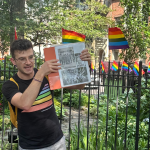

Recently on tours, I’ve started stopping at a particular photo displayed outside of Christopher Park. The image captures a pivotal moment in LGBTQ+ history – the first Christopher Street Gay Liberation Day, which occurred on June 28, 1970. This historic event began as an annual protest march and demonstration to commemorate the Stonewall Riots. Over time, it transformed into something much larger: a national and global celebration of LGBTQ+ rights, with billions of people marching across the world. Today, we proudly call this celebration Pride.

And while many are familiar with the celebrations around Pride, fewer people know about the visionary activist who helped bring it to life – Craig Rodwell. Born in 1940 in Chicago, Craig Rodwell was an LGBTQ+ activist for most of his life. He moved in NYC when he was 18 years old and quickly became a member of the Mattachine Society, an early pre-Stonewall gay rights organization, participating in the famous Julius’ Sip-In of 1966.
Before the Sip-In, Rodwell was also an active participant in the annual “Reminder Day” demonstrations in front of Independence Hall in Philadelphia, from 1965 to 1969, which were among the earliest significant LGBTQ+ protests in the United States, highlighting the community’s lack of basic civil rights.
The world of LGBTQ+ activism was shaken significantly by the Stonewall Uprising in June 1969, a series of protests that were sparked by a police raid of Greenwich Village’s gay bar, the Stonewall Inn. During the nights of the Uprising, Rodwell created a flyer that boldly called: “Get the Mafia & Cops Out of Gay Bars.” He encouraged gay businessmen to open legal bars that would not overcharge patrons, with a “healthy social atmosphere.” This was a drastic difference from the then-mafia-owned Stonewall Inn. At the time, Rodwell was a gay businessman himself, owning the Oscar Wilde Memorial Bookshop, considered to be the first gay and lesbian bookstore on the east coast.

The last Reminder Day demonstration took place on July 4, 1969, only one day after the end of the Stonewall Riots. Rodwell chartered a bus of young people from New York, who joined the Philadelphia demonstration, but did not adhere to the strict conservative dress code, nor did they follow the “orderly” rules of conduct of previous years. So, as an alternative, Rodwell began to hold meetings in this apartment in October of 1969 to discuss an action to replace the Reminder Days. In attendance was his boyfriend, Fred Sargeant, as well as members of the newly formed Gay Liberation Front, Ellen Broidy and Linda Rhodes, and activist Foster Gunnison, Jr. Together, they developed an idea for “Christopher Street Liberation Day.”
In November 1969, members of the group attended the final annual Eastern Regional Conference of Homophile Organizations (ERCHO) in Philadelphia, and there, a resolution was passed for an annual demonstration to be held, to commemorate the Stonewall Riots, called Christopher Street Liberation Day. Rodwell then organized the Christopher Street Gay Liberation Day Umbrella Committee to plan this historic event.
The first March took place on Sunday, June 28, 1970, on the one year anniversary of the Stonewall Riots. Hundreds of participants kicked off at noon, and followed a route up Sixth Avenue all the way to Central Park, where they ended with a “Gay-In” demonstration in Central Park’s Sheep Meadow. For many, it was their first time publicly advocating and/or being out in a public place. While exhilarating, it was also nerve-wracking and incredibly brave. Some of the chants heard included “Out of the closets, into the streets!” and “Two, four, six, eight! Gay is just as good as straight!” The march ultimately attracted an estimated 5,000 of participants, with The New York Times reporting that the marchers took up the entire street for about 15 blocks.

Christopher Street Liberation Day very quickly spread to other cities, other states, and other countries, and now, most places around the world call it “Pride.” So, why do I now stop and tell this story on our Village Pride tour? Well, my hope in sharing this story is that tour participants realize the profound impact that one individual person can have. Craig Rodwell’s vision serves as a powerful and timely reminder that change often starts with a single idea and the courage to pursue it. I always end our tours by saying something to the effect of “While we’ve come a long way, there’s still a long way to go.” And with where we are today – where the existence and rights of LGBTQ+ people continue to be challenged and erased – it’s more important than ever before to remember activists like Craig. His legacy reminds me that each of us possess unique skills, gifts, and talents that can drive positive social change.
Let’s honor Craig Rodwell’s legacy by taking action, standing up for our community, and inspiring others to do the same.