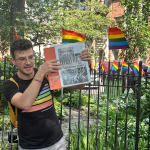
Each year, we welcome hundreds of students on our LGBTQ+ Village Pride tour. Student tours hold a special place in our hearts, as Christopher Street Tours was founded with the mission in mind of making LGBTQ+ history more accessible, particularly for students who so often do not learn about queer history. For LGBTQ+ students in particular, it’s so important that they are learning their own history. Representation in history is life-changing and life-saving.
Joining on an LGBTQ+ tour is an incredible way for students (and everyone else!) to see the actual sites where the history happened. And it’s more than a nice field-trip…it’s also the heart of an educational approach known as place-based learning.
What is place-based learning?
Place-based learning is the idea that the best classroom isn’t always a physical classroom. Instead of studying a subject in the textbooks (which is also incredibly important), students can also learn through the places, communities, and stories right in front of them. History stops being a list of dates in a textbook and becomes something you can stand inside of. Educators have long used this approach in fields like environmental science, geography, and local history, and it’s increasingly recognized as a discipline in its own right, one built on the belief that where you learn shapes how deeply you learn.
LGBTQ+ history is a perfect fit, especially in the work that we do with LGBTQ+ walking tours. So much queer history was never written down in official records, and queer written history is relatively recent. Otherwise, we rely on oral history passed down from generations. And much of queer history happened in ordinary-looking places: a bar, a park, a street corner, an apartment building. Without someone to point out that a doorway mattered, you’d walk right past it. A tour makes the invisible visible.
Why a tour works
When students stand outside the Stonewall Inn, or in the park across the street where crowds gathered in 1969, something shifts. The people in the story stop being names and become real people who stood on this very pavement, who were inspired and angry and brave. Students can look up at the same buildings, hear the same city sounds, and begin to understand that history is made by people not so different from themselves.
Walking also changes the dynamic. There are no desks, no worksheets, and no pressure to have the right answer. Students ask questions as they come up, notice details, and make connections on their own. A story told on location sticks in a way that a lecture rarely does.
Seeing yourself in the story
For LGBTQ+ students, this matters on a deeper level. Many grow up without ever seeing people like themselves in the history they’re taught. Learning that queer people have always existed, built communities, fought for each other, and won hard-fought victories can be profoundly affirming. It tells them they come from somewhere and that they are part of a long, proud lineage.
For allied students, the experience builds empathy and understanding. They leave knowing that LGBTQ+ history is American history, not a footnote or a special topic, but a central thread in the story of civil rights, community, and resilience.
Bringing your students to the Village
Our Village Pride tour is designed with student groups in mind, with age-appropriate storytelling, room for questions, and a welcoming environment for every student. We’re happy to work with teachers to connect the tour to what you’re already covering in class, whether that’s social studies, civil rights, literature, or community studies.
If you’re an educator, a school administrator, or a parent organizer interested in bringing a group, we’d love to hear from you!